
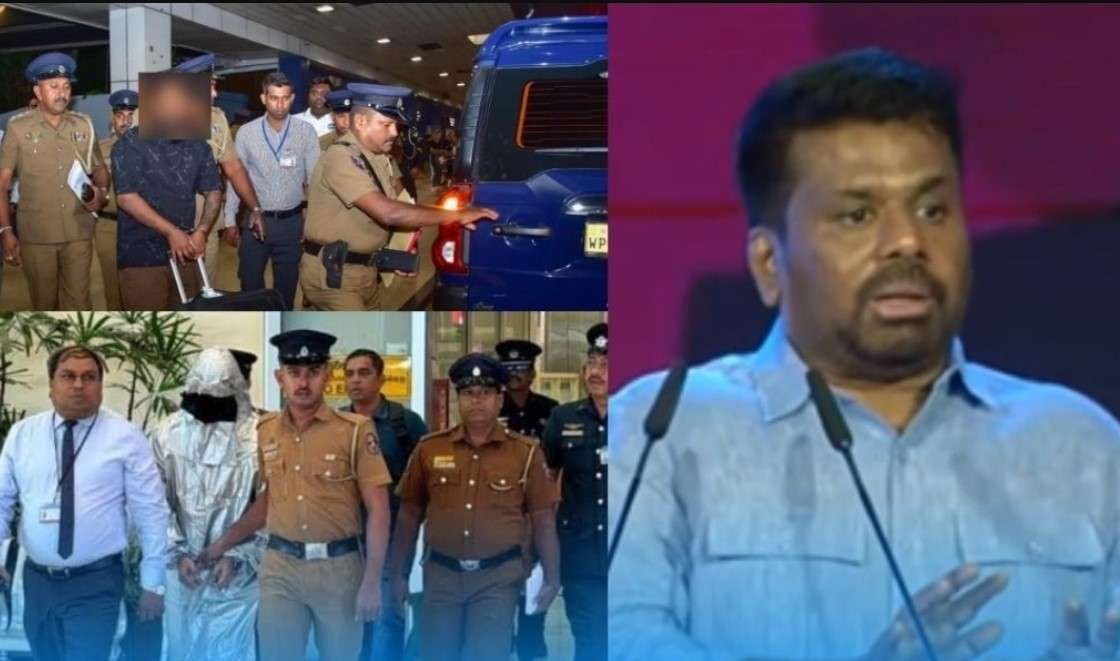
‘Shadow state’ operating within Sri Lanka: 11 key points from President AKD’s speech
President Anura Kumara Dissanayake has warned that a powerful “shadow state” has emerged within Sri Lanka, with drug traffickers and organised criminal gangs allegedly using their enormous wealth to influence politicians, police officers, government officials and other state institutions.
Addressing a religious summit at Temple Trees to mark the first anniversary of the national anti-drug operation, the President said an underground criminal network had developed alongside the legitimate state machinery, posing a serious threat to the country’s future.
He said drug traffickers had accumulated sufficient wealth to influence state institutions, infiltrate politics and establish networks capable of undermining law enforcement.
The President also outlined major drug seizures, the arrest of suspected organised criminals, the recovery of criminal assets and proposed changes to controversial legislation.
Here are 11 key points from the President’s speech.
1. A ‘shadow state’ operating within Sri Lanka
President Dissanayake claimed that a powerful criminal network had emerged within the country, operating as a parallel or “shadow state” linked to drug trafficking and organised crime.
He alleged that drug money had been used to influence officials in the Customs Department, Department of Motor Traffic, Department of Immigration and Emigration, the Police and other state institutions.
He also claimed that drug traffickers had financed political movements and secured positions in local government bodies.
The President said the government was determined to dismantle the network, warning that Sri Lanka’s younger generation would not have a secure future unless the criminal structure was defeated.
2. Drugs worth Rs. 224 billion seized
The President revealed that authorities had seized narcotics valued at approximately Rs. 218 billion over the past year, increasing to Rs. 224 billion when cannabis was included.
He said seizures of narcotic drugs included:
– ICE (crystal methamphetamine): 6,528 kilograms
– Heroin: 4,000 kilograms
– Hashish: 1,841 kilograms
– Cocaine: 314 kilograms
– Other drugs: 2,598 kilograms
– Drug tablets and capsules: Nearly 4.5 million
He also revealed that approximately 150 kilograms of heroin and ICE had been seized earlier in the day.
The President said these seizures demonstrated the scale of the illegal drug trade, warning that the quantities reaching the market could be significantly higher.
3. Govt ready to reduce detention period from 72 to 48 hours
President Dissanayake announced that the government was prepared to introduce three amendments to the proposed Prevention of Organised Crimes Bill following concerns raised before the Supreme Court.
The proposed changes include reducing the detention period from 72 hours to 48 hours.
The government is also prepared to remove provisions concerning the identification of organised criminal gangs through tattoos and the application of the proposed legislation to offences under the Excise Ordinance.
The President said the government was willing to discuss further concerns raised by those advocating for democracy and fundamental rights.
4. No one remains in power forever
Responding to criticism of the proposed legislation, the President said neither he nor his government wanted excessive powers.
He stressed that political leaders should exercise authority with the understanding that they may eventually have to surrender it.
The President said governments must consider how the laws they introduce would operate when they are no longer in power.
He also noted that citizens could withdraw the authority given to a government through elections.
5. 67 suspected criminals brought back from overseas
The President said 67 individuals linked to organised criminal activities had been brought back to Sri Lanka from overseas during the past year.
He also revealed that red notices had been issued against 112 individuals.
Warning those involved in Sri Lanka’s drug trade and organised crime who were hiding overseas, he said they would not be safe from law enforcement regardless of their location.
He said the government would continue efforts to apprehend individuals allegedly operating criminal networks from foreign countries.
6. Rs. 4.5 billion in suspected criminal assets frozen
President Dissanayake revealed that authorities had frozen assets worth approximately Rs. 4.5 billion allegedly acquired through drug trafficking.
He said legislation introduced in 2025 to recover unlawfully acquired assets had strengthened the government’s ability to target wealth generated through organised crime.
The President stressed that dismantling the financial networks supporting drug traffickers was essential to defeating organised crime.
7. Hundreds of firearms seized from criminal networks
The President revealed that authorities had seized significant quantities of firearms during operations against organised criminal groups.
According to the President’s Media Division’s English statement, the seizures included 97 T-56 assault rifles, 143 pistols, AK-47 rifles and 105 revolvers.
He claimed that some weapons had originated from the armed forces, with audit reports revealing that firearms had been diverted from military stocks.
He also referred to incidents involving police officers allegedly selling firearms.
The President warned that the availability of such weapons among criminal groups posed a serious threat to public safety.
8. Drug menace has reached religious institutions
President Dissanayake warned that the drug problem had spread across almost every section of society, including religious institutions traditionally held in high regard.
He said the menace had also affected the Police, armed forces and other government institutions.
The President urged Buddhist monks, Christian clergy, Muslim religious leaders and Hindu priests to take an active role in changing social attitudes and supporting families affected by drug addiction.
He said religious leaders were often among the first people approached by families facing drug-related problems and could play an important role in prevention and rehabilitation.
9. Sharp increase in children arrested over ICE drugs
The President highlighted what he described as an alarming increase in drug-related arrests involving children.
He said only one individual under the age of 18 had been arrested in connection with ICE in 2022, compared with 1,874 in 2025.
He warned that the spread of narcotics among children and young people threatened Sri Lanka’s future.
The President also announced that the Ministry of Education was developing awareness programmes specifically targeting parents to help them identify and prevent drug-related problems within families.
10. Govt rules out punishment outside the law
President Dissanayake stressed that his government would not adopt a policy of punishing suspected drug traffickers or organised criminals outside the legal system.
He said suspects must be investigated, prosecuted and punished through the courts in accordance with the law.
The President acknowledged that delays in criminal investigations and court proceedings remained a major challenge.
He said the government was strengthening the Police, Attorney General’s Department, Government Analyst’s Department and judiciary to accelerate the prosecution of criminal cases.
According to the President, a backlog of approximately 36,000 Government Analyst reports had accumulated, while additional staff, allowances and infrastructure support had been provided to improve processing capacity.
He also outlined plans to strengthen rehabilitation facilities, including centres operated by religious institutions and civil society organisations.
11. Govt plans to weaken PTA while introducing stronger organised crime laws
President Dissanayake said the government intended to substantially reduce the powers of the Prevention of Terrorism Act (PTA).
He acknowledged that the PTA had been used against organised criminals because existing legislation was inadequate to address certain offences.
The President said the government wanted to introduce stronger laws specifically targeting organised crime while reducing reliance on anti-terrorism legislation.
He also acknowledged concerns raised by civil society organisations over the proposed Prevention of Organised Crimes Bill and said the government was prepared to consider amendments to protect fundamental rights.
The President maintained that Sri Lanka required effective legislation to tackle the growing threat posed by drug trafficking and organised criminal gangs.
Calling for national unity, President Dissanayake said Sri Lanka now faced two groups: those supporting the criminal state built around drugs and armed gangs, and those opposing it.
He urged religious leaders and the wider public to set aside political and other differences and become active partners in the government’s anti-drug campaign.
The President also launched the official website, www.1818.gov.lk, for the “Ratama Ekata” national operation.
He said the drug crisis could not be eliminated within one or two years, but sustained efforts over several years could help create a safer future for Sri Lanka’s younger generation.
Local News
Group of foreign nationals arrested in Maradana over online scams
03 November 2026
Sri Lanka to recruit 13,000 nurses over next three years
01 November 2026
Woman arrested at BIA over Rs. 1.45 million WhatsApp gift scam
31 October 2026
Trending News
SIMs to be deactivated on unregistered new mobile devices from tomorrow
30 September 2020
CSE ASPI touch all-time high of 10,037.61
27 October 2021
Popular actress Sureni Senarath passes away
26 May 2021